

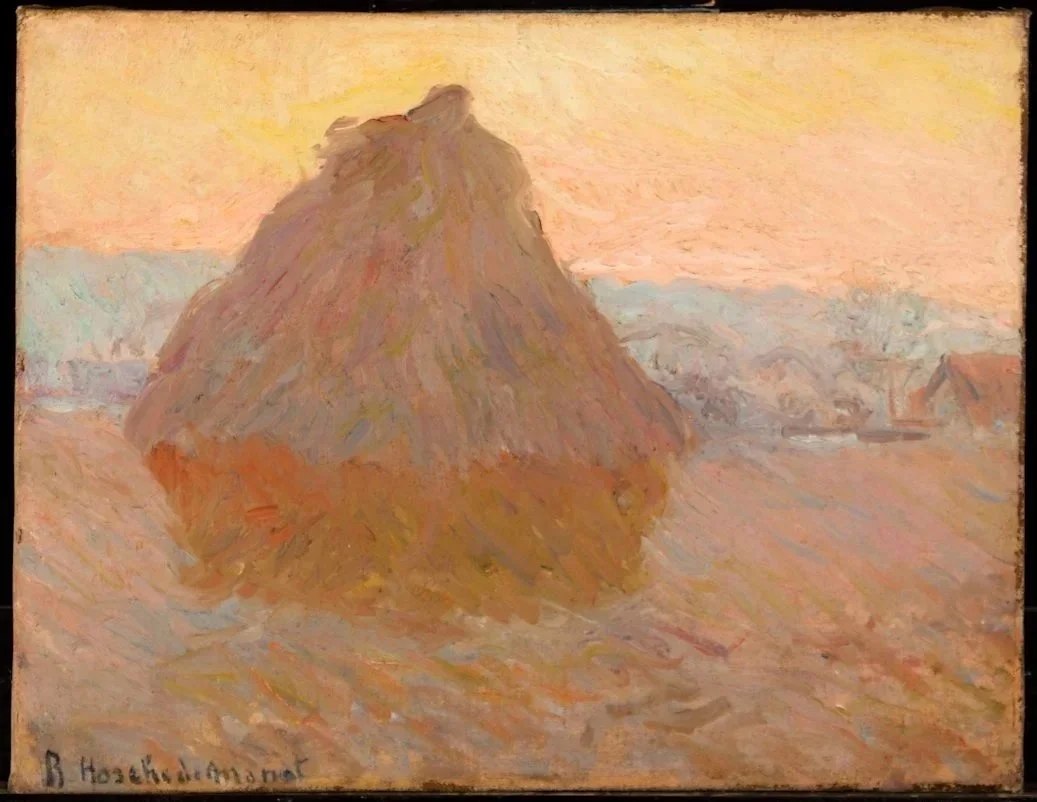
Blanche Hoschedé-Monet and Haystack at Giverny, (1889)
In the late summer of 1889, Blanche Hoschedé-Monet painted a small but remarkable oil on canvas depicting a haystack in Giverny. Executed during the period when she was living and working in proximity to Claude Monet, this work belongs to Blanche Hoschedé-Monet’s earliest mature phase. It offers a rare insight into her artistic independence within the Impressionist movement.
The painting, known as Haystack at Giverny (also referred to as Meule de foin à Giverny), was executed in Clos Martin, a meadow located west of Monet’s house. This field was used by a local farmer named Quérel to store harvested grain. From this site, Blanche Hoschedé-Monet captured a view oriented toward the southwest, where the hills of Giverny extend along the left bank of the Seine. The motif—humble, rural, and transient—was deeply embedded in the visual culture of Giverny during the late 1880s.
The subject of the haystack was not a neutral choice. By the time Blanche painted this work, Claude Monet had already begun exploring the haystack motif that would culminate in his celebrated series of 1888–1891. These paintings marked a decisive moment in the development of Impressionism, as Monet turned away from narrative subject matter toward the systematic study of light, atmosphere, and time. Blanche Hoschedé-Monet was fully immersed in this environment. She did not merely observe Monet’s practice; she painted alongside him, sharing both palette and working conditions.
Yet Haystack at Giverny should not be understood as a derivative work. Blanche’s handling of the motif reveals a distinct sensibility. The haystack occupies a central position, but it does not dominate the composition. Instead, it participates in a subtle orchestration of color and light. Warm tones of gold, ochre, and brown radiate from the stack and the surrounding soil, while the distant hills are rendered in cooler blues and violets. The sky, suffused with the light of late afternoon, acts as a luminous envelope rather than a descriptive backdrop.
This chromatic dialogue produces an effect that is at once intimate and theatrical. The landscape appears almost staged, as if the rural elements of Giverny—fields, hills, and sky—had been arranged for a fleeting performance of light. The painting captures a precise moment: the transition from day to evening, when sunlight floods the scene at a low angle, intensifying color while softening form. Blanche Hoschedé-Monet’s brushwork remains restrained, avoiding the more fragmented touch found in some of Monet’s contemporaneous works, and instead favoring a measured synthesis of observation and feeling.
The work’s provenance further underscores its personal and historical significance. Haystack at Giverny was gifted by the artist to her sister, Marthe Hoschedé, as attested by an inscription written on the stretcher bar: a tender message dated July 29, 1889. This inscription anchors the painting not only in time and place but also within the intimate family circle that surrounded Monet at Giverny. The painting subsequently descended through the Hoschedé and Butler families, remaining in private hands and preserving its original context.
Blanche Hoschedé-Monet’s position within Impressionism has long been overshadowed by her proximity to Claude Monet. However, works such as Haystack at Giverny compel a reassessment. While her palette and subject matter clearly reflect the influence of Monet, her approach reveals an artist attentive to balance, structure, and emotional nuance. The haystack, a symbol of rural labor and seasonal cycles, becomes in her hands a vehicle for personal expression rather than serial experimentation.
It is worth noting that Claude Monet himself recognized Blanche’s talent. His dealer, Paul Durand-Ruel, acquired a haystack painting by Blanche Hoschedé-Monet, which today hangs in Monet’s house at Giverny—an extraordinary acknowledgment of her artistic standing within the Impressionist circle. Such recognition situates Blanche not as a peripheral figure but as an active participant in the visual culture of Giverny.
When viewed alongside Monet’s Haystack at Giverny, the Evening Sun (1888), now in the collection of the Museum of Modern Art, Saitama, Blanche’s painting reveals both dialogue and distinction. Where Monet pursued serial variation and optical analysis, Blanche focused on a singular, poetic moment. Her work does not seek to exhaust the motif but to distill it.
Today, Haystack at Giverny stands as a rare and eloquent testament to Blanche Hoschedé-Monet’s artistic voice. Painted at the heart of Impressionism, within the physical and intellectual landscape of Giverny, it reflects both the shared ambitions and the individual paths that defined this extraordinary artistic milieu.
BLANCHE HOSCHEDÉ-MONET (1865–1947)
Haystack at Giverny (Meule de foin à Giverny), 29 July 1889
Signed lower left: B. Hoschedé-Monet
Oil on canvas: 27 × 35 cm
Provenance
:Gift from Blanche Hoschedé-Monet to her sister, Marthe Hoschedé;
by descent in the Hoschedé / Butler family.
Inscription (stretcher bar, pen):“Bonne Fête ma Marthe Chérie…Blanche29 Juillet 1889”